Highest reading on record for the BCR Romania Manufacturing PMI in March
New orders and output fall at the slowest rates on record - Declines in purchasing and input stocks ease - Firms choose to largely bear cost inflation burden to encourage sales
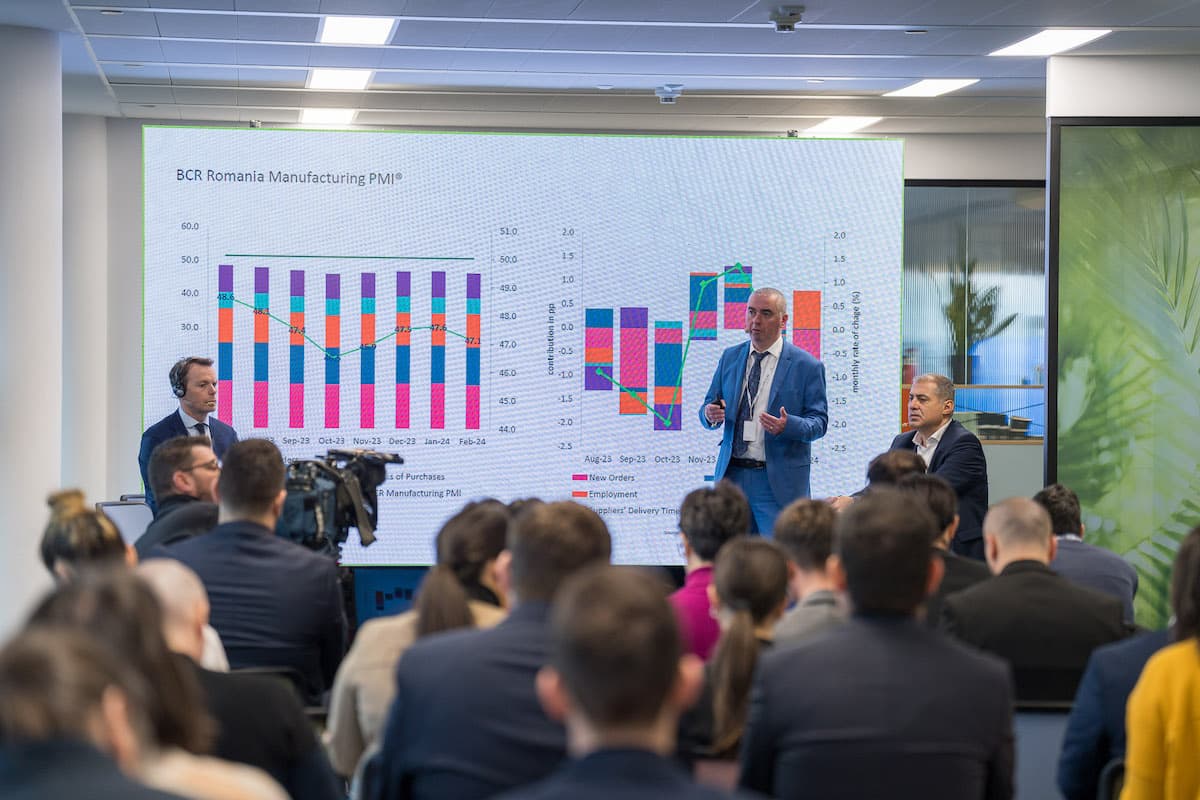
- New orders and output fall at the slowest rates on record
- Declines in purchasing and input stocks ease
- Firms choose to largely bear cost inflation burden to encourage sales
Romania's manufacturing economy remained just inside contraction territory at the end of the first quarter, although the health of the sector deteriorated to the least extent in the nine-month survey history so far. Both output and new orders continued to decline in March, but at the slowest rates on record. Meanwhile, firms continued to utilise current input inventories while cost inflation remained elevated. Despite sharply rising input costs, selling prices were increased only slightly in March, with some firms discounting charges to encourage new sales.
The headline BCR Romania Manufacturing PMI® is a composite single-figure indicator of manufacturing performance derived from indicators for new orders, output, employment, suppliers’ delivery times and stocks of purchases.
A PMI reading above the 50.0 no-change mark signals an improvement in the health of the sector over the month, while a figure below 50.0 points to a deterioration.
Posting at 49.3 in March, up from 47.1 in February, the headline PMI indicated the softest deterioration in operating conditions for Romanian manufacturers since the survey began in July 2023.
Central to the improved headline reading was a lower contraction of new orders, in addition to softer declines in both output and preproduction inventories. The only negative directional influence on the PMI was slightly sharper job shedding.
According to panel members, an unfavourable economic climate and tight customer budgets led to muted demand for Romanian manufactured goods. Though new orders have fallen in each month since data collection began in July, March recorded the softest decline in the survey's history.
Concurrently, a further drop in new export orders weighed on total sales in March, reflecting subdued demand from abroad. Although the weakest since data collection began in July, the rate of contraction was nevertheless solid.
Subsequently, manufacturers across Romania recorded another drop in production volumes in March, thereby stretching the trend of reductions to nine months. That said, the speed of decline was only modest and also the slowest on record.
The drop in new work pushed firms towards working through their backlogs. The level of outstanding business has fallen in each month of the past three quarters, with some firms blaming subdued order numbers and others attributing backlog completion to increased productivity. The rate of depletion was solid and the fastest recorded this year so far. At the same time, Romanian manufacturers continued to cut jobs in March, though only slightly.
Free newsletters
Romania, in your inbox before your first coffee.
Get the Daily — the morning briefing, free, in English, unsubscribe anytime. Want business, real estate or travel digests too? Pick your newsletters →