Cristian Geanaliu, Executive Director, Global Markets, Garanti BBVA Romania: Inflation between monetary policy and fiscal reality
Cristian Geanaliu, Executive Director of Global Markets at Garanti BBVA Romania, analyzes the persistent inflation and the ongoing imbalance between monetary and fiscal policies shaping Romania’s economic outlook for 2026.

Cristian Geanaliu, Executive Director of Global Markets at Garanti BBVA Romania, analyzes the persistent inflation and the ongoing imbalance between monetary and fiscal policies shaping Romania’s economic outlook for 2026.
Romania enters the last quarter of 2025 within a complex macroeconomic framework. An inflation rate well above the central bank’s target, high interest rates, a persistent budget deficit, and mounting pressures on public finances will continue to shape the economic trajectory in 2026, a year likely to be marked by efforts toward fiscal adjustment and the consolidation of the macroeconomic stability.
Inflation remains above the National Bank of Romania’s target, while the key policy rate is still maintained at 6.50%, a high level, following a tightening cycle that started relatively later than in other Central and Eastern European countries but continued decisively.
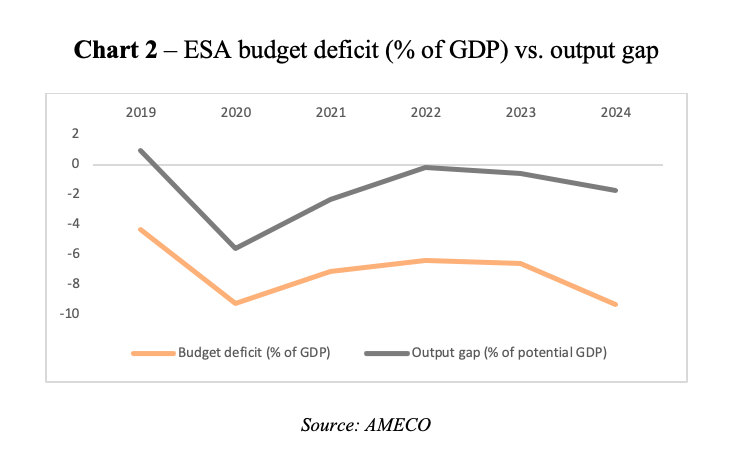
In parallel, fiscal policy is undergoing a phase of structural adjustment, which has included, among other measures, increases in certain indirect taxes (VAT and excise duties) and the removal of the electricity price cap. Although these measures aim to achieve medium-term fiscal consolidation, they also generate immediate inflationary pressures and pose challenges to coordination with monetary policy. Even with the introduction of measures intended to curb aggregate demand, fiscal policy is not completely restrictive overall. High expenditure levels and existing commitments remain expansionary, maintaining upward pressure on the budget.
The evolution between 2019 and 2025 of the monetary policy rate, the annual inflation rate, and the adjusted CORE2 inflation rate illustrates the gradual transition of monetary policy from an accommodative to a restrictive stance. During the 2019–2021 period, the monetary policy rate remained below the inflation rate, resulting in negative real interest rates and giving monetary policy a procyclical character. Under these conditions, lending and consumption were stimulated, fueling inflationary pressures.
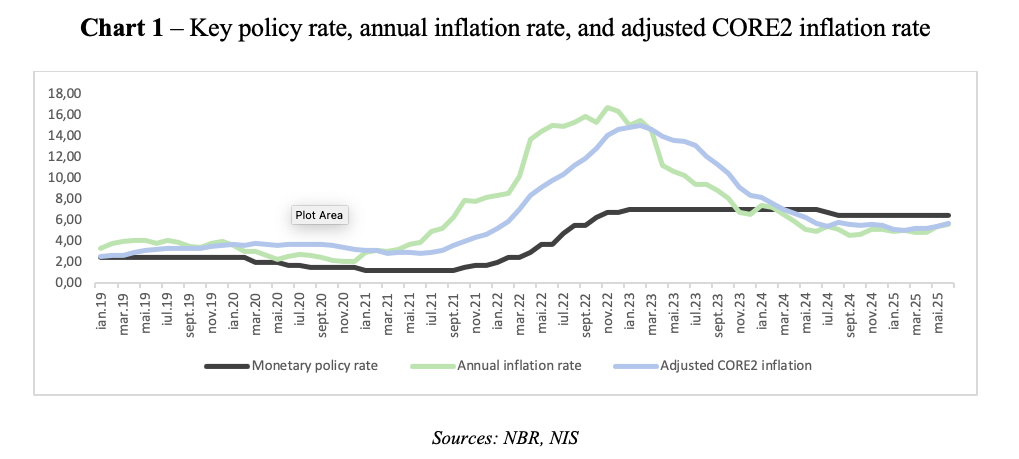
Subsequently, amid energy and geopolitical shocks, inflation accelerated sharply, exceeding 17% and prompting Romania’s central bank to initiate a rapid monetary tightening cycle. The increase of the key policy rate from 1.75% to 7.00% by the end of 2023 marked a shift toward a restrictive policy stance, characterized by positive real interest rates and a firmer anchoring of inflation expectations.
However, the transmission of the monetary policy decisions to the real economy proved to be asymmetric. While ROBOR reacted almost immediately to policy rate changes, IRCC adjusted with a significant lag, reflecting structural differences between the interbank market and household lending, partially coming from the IRCC definition. This delay mitigated the short-term impact of restrictive measures on domestic demand, contributing to the persistence of inflation above target band. Moreover, the lack of alignment with fiscal policy weakened monetary transmission, forcing NBR to keep high interest rates for an extended period amid ongoing inflationary pressures and persistent structural deficits.
Free newsletters
Romania, in your inbox before your first coffee.
Get the Daily — the morning briefing, free, in English, unsubscribe anytime. Want business, real estate or travel digests too? Pick your newsletters →